What Does a Healthy Relationship with Food Look Like?
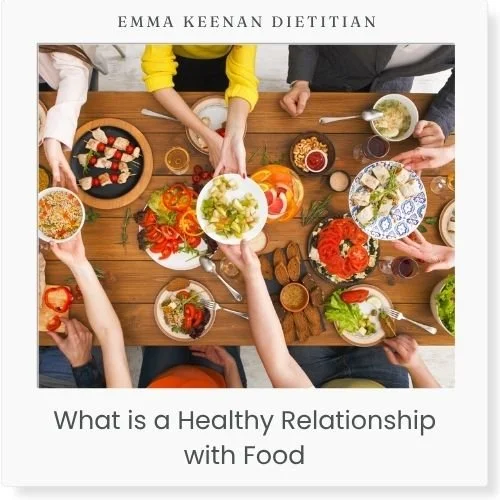
It’s incredibly easy to get pulled into the tornado of diet culture and nutrition misinformation. It’s loud, it’s everywhere, and it’s extremely profitable.
We’re constantly being sold confusing, often contradictory rules about what, when and how much we should — or shouldn’t — eat.
The messaging is relentlessly black and white:
what to eat and what to avoid
when to eat and when not to
how much to eat and how much to restrict
— always ending with the same underlying threat of weight gain.
The truth is, you’ve been taught to look in the wrong places — outside of yourself. You were born with an innate sense of what to eat, when to eat, and how much to eat. You only have to look at babies and young children to see this in action; parents aren’t pulling out calorie counters to calculate how much food their children need.
The rules and conditioning start early. We’re taught to override our internal cues almost as soon as we can eat independently — from being told to finish everything on our plate, even when we’re full, to being denied dessert unless our dinner plate is clean. We learn that satisfaction and pleasure with food must be earned, and that listening to our body comes second to external rules.
We’re also taught to moralise food. Sweets become “bad”, vegetables become “good” and eating turns into a test of willpower rather than a response to hunger, appetite, and enjoyment. Over time, these messages teach us to distrust our bodies, ignore hunger and fullness, and attach guilt or shame to eating certain foods.
Long before diet culture formally enters the picture, many of us have already learned the lesson: our bodies can’t be trusted, and food must be controlled. It makes sense, then, that we spend our lives jumping on the latest and greatest trend — because we’ve been taught that someone else has the answer.
All along, the answer has always been within you.
What is Normal Eating?
“Normal eating is competent eating.
It is going to the table hungry and eating until you are satisfied.
It is being able to choose food you like and eat it and truly get enough of it — not just stop eating because you think you should.
Normal eating is being able to give some thought to your food selection, so you get nutritious food, but not being so wary and restrictive that you miss out on enjoyable food.
Normal eating is giving yourself permission to eat sometimes because you are happy, sad or bored, or just because it feels good.
Normal eating is mostly three meals a day, or four or five, or it can be choosing to munch along the way.
It is leaving some cookies on the plate because you know you can have some again tomorrow, or it is eating more now because they taste so wonderful.
Normal eating is overeating at times, feeling stuffed and uncomfortable. And it can be overeating at times and wishing you had more.
Normal eating is trusting your body to make up for your mistakes in eating.
Normal eating takes up some of your time and attention but keeps its place as only one important area of your life.
In short, normal eating is flexible. It varies in response to your hunger, your schedule, your proximity to food, and your feelings”.
- Ellyn Satter
Finding Your Way Back: Working With a NOn-Diet Dietitian
Undoing years sometimes decades of conditioning isn’t something you have to do alone. If you’ve spent most of your life following external rules, the idea of “trusting your body” can feel terrifying or even impossible. This is where a non-diet dietitian comes in.
Rather than handing you a meal plan or a list of foods to avoid, a non-diet dietitian supports you in healing your relationship with food so you can reconnect with your own internal appetite cues.