

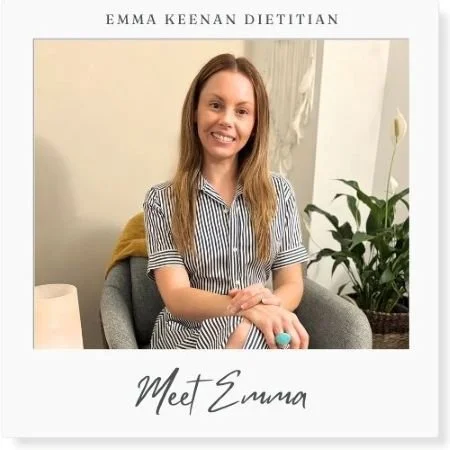
Meet Emma Accredited Practising Dietitian (APD)
Hello & Welcome
Hi, I’m Emma (she/her), I’m an Accredited Practising Dietitian (APD) and Credentialed Eating Disorder Clinician.
I Support Clients To
⬜Improve their health and wellbeing
⬜Eat for physical and mental health, and social wellbeing
⬜Learn about nutrition without the noise of diet culture
⬜Access care, that is free from judgement
I provide weight-neutral, fat-positive, and body-inclusive care. I acknowledge that health and bodies come in all shapes, weights, and sizes
Areas of Interest
⬜Eating disorders and disordered eating
A Little About Me
I love exploring local markets, op-shopping, altering clothes, listening to music and attending gigs. I also enjoy soaking up the sunshine outdoors. You’ll often find me walking along the beach, reading in the park, or heading out for a hike.
I love to travel. For me, the heart of a new culture is found in its food stores. I find wandering through local markets just as exciting as museums.
Menu Items I Can’t Resist
⬜Anything with truffle oil
⬜Confit duck
⬜Salted caramel EVERYTHING!
My Favourite Snacks
⬜Dark chocolate
⬜Sour lollies
⬜Anything artificial grape flavoured
⬜Pickles, cheese, kewpie on toast
Qualifications & Professional Development
Accredited Practising Dietitians in Australia must complete a minimum of 30 hours of Continuing Professional Development (CPD) annually. Credentialed Eating Disorder Dietitians must complete a minimum of 15 hours of CPD relevant to eating disorders, along with a minimum of 6 hours of supervision each year.
Qualifications
⬜Master of Dietetic Practice, La Trobe University
⬜Bachelor of Applied Science, La Trobe University
Professional Memberships
⬜Dietitians Australia, Accredited Practising Dietitian (APD)
⬜Australia New Zealand Academy for Eating Disorders (ANZAED) Credentialed Eating Disorder Clinician
continuing professional development
⬜Gut Health: Monash University Low FODMAP Diet for Irritable Bowel Syndrome (IBS), Gastrointestinal Nutrition for Dietitians, and Gut Smart Nutrition and Inflammatory Bowel Disease (IBD) for Dietitians
⬜Eating Disorders: InsideOut The Essentials: Training Clinicians in Eating Disorders, Mindful Dietitian Eating Disorder Training for Dietitians, ELL Compassionate Approach to Eating Disorders in Higher Weight Bodies, GLP-1 Agonists and Eating Disorders, Managing Digestive Concerns in Eating Disorders
⬜Women’s Health: Optimising nutrition for PMOS (formerly PCOS), endometriosis & gut health, Evidence-based nutrition to navigate perimenopause & menopause
⬜Other: Mindful Eating Essentials, Neurodiversity Affirming Dietetic Care and Gender Affirming Care
Philosophy & Approach
To see the human who lives in the body
Purpose
My goal is to support clients in building a healthy relationship with food and their bodies through evidence-based, weight-inclusive nutrition care.
This approach respects each person’s biology, autonomy, and lived experience. It supports people to care for their health in ways that are sustainable and meaningful, while making space for a full life beyond food, nutrition, and health.
Vision
I hope to see a society that recognises the complexity of health, rather than reducing it to a number on a scale or BMI chart.
I am committed to a future where the specialised expertise of dietitians is better understood and valued. Dietitians do far more than prescribe meal plans or focus on weight loss. Our work is about helping people nourish themselves in ways that support their health, wellbeing and quality of life.
Approach
Too often, weight is treated as both the cause of, and solution to, health concerns. But health is complex, and it cannot be understood through weight alone.
Weight-inclusive care is a healthcare approach that prioritises overall health and wellbeing rather than body size or weight. It recognises that people come in a wide range of shapes and sizes, and that everyone deserves compassionate, respectful and comprehensive healthcare without their care being conditional on reaching a particular BMI, body size or number on the scale.
Supporting your health means caring for your whole self. Nutrition is one part of this, alongside your eating patterns, relationship with food, movement, sleep, stress, relationships, environments, and access to healthcare.
In my experience, when weight becomes the primary focus of healthcare, other important aspects of health can be overlooked. A whole-person approach looks beyond weight to consider everything that shapes your health and wellbeing including your biology, mind, social connections, environments, and life experiences.
The beauty of nutrition science is that there is no single way to eat well. There are many ways to meet your nutrition needs, and what works for one person may not work for another.
Together we can find an approach that works for your body, lifestyle, culture, preferences, and circumstances — without rigid rules, fear-based nutrition messaging, or the assumption that your body is a problem that needs fixing.
Accredited Practising Dietitian FAQs
Still have questions? Take a look at the FAQ page or reach out anytime. If you’re feeling ready, you’re welcome to schedule an appointment.
What is Dietitians Australia (DA)?
Dietitians Australia is the professional body for Accredited Practising Dietitians in Australia. It sets standards for education, ethics, and ongoing professional development.
What is an Accredited Practising Dietitian (APD)?
An Accredited Practising Dietitian (APD) is a university-qualified health professional who specialises in nutrition.
In Australia, APDs are the only nutrition professionals recognised by the Australian Government, Medicare, the Department of Veterans' Affairs, the National Disability Insurance Agency (NDIA), and most private health funds.
What is the ANZAED Eating Disorder Credential for Dietitians?
The Australia and New Zealand Academy for Eating Disorders (ANZAED) eating disorder credential for dietitians provides formal recognition of a dietitian’s qualifications, knowledge, training, and professional development activities needed to meet minimum standards for the delivery of safe and effective eating disorders treatment.
Why Choose an Accredited Practising Dietitian (APD)?
APD’s provide evidence-based nutrition advise tailored to your individual needs.
Working with a dietitian can be especially helpful if you have a health condition, a diagnosed nutrient deficiency, or feel confused by conflicting nutrition advice.
You may benefit from seeing a dietitian if you are experiencing:
⬜Medical conditions
If you have a condition such as diabetes, Crohn’s disease, ulcerative colitis, irritable bowel syndrome (IBS), coeliac disease, diverticular disease, high cholesterol, or high blood pressure. A dietitian can help you manage your nutrition and condition with medical nutrition therapy.
⬜Vitamin or mineral deficiencies
If you have been diagnosed with a nutrient deficiency, are concerned you may be at risk of deficiency or may not be meeting your nutrition needs.
⬜Confusing nutrition advice
If you feel overwhelmed by conflicting diet information and want clear, evidence-based guidance.
⬜Life-stage changes
Nutrition needs change during adolescence, pregnancy, breastfeeding, perimenopause, post-menopause, and in older adults. A dietitian can help you adjust your nutrition during these transitions.
⬜Support outside of diet culture
If you feel stuck in the cycle of dieting and want a more sustainable, he⬜alth-focused approach to eating.
Emma is an Accredited Practising Dietitian (APD).