
Why is Nutrition Important for Health?
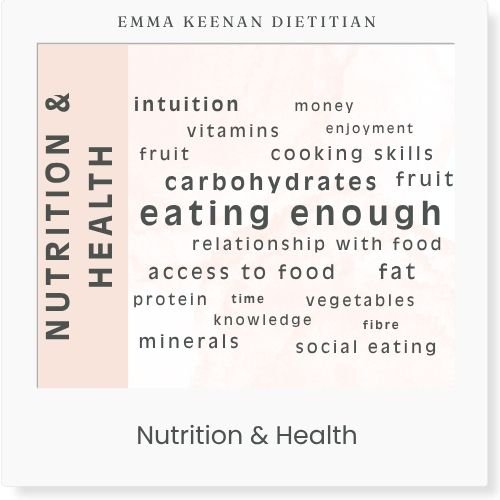
In a culture that continues to sell dietary restriction as health, understanding the true role of nutrition in supporting our health and wellbeing is more important than ever.
What is Health?
Health is a state of wellbeing, influenced by the complex interplay between a person’s genetics, lifestyle, and the environments in which we live.
The World Health Organisation definition “Health is a state of complete physical, mental, and social well-being and not merely the absence of disease or infirmity”.
For Aboriginal and Torres Strait Islander people, and other diverse communities, health also includes cultural wellbeing.
What Influences Health?
Generally, a person’s health is influenced by two key factors:
Determinants of health: the social, environmental, biological, and other factors that shape health outcomes
Interventions: the actions and resources used to promote, maintain, or improve health.
Nutrition & The Human Body
To understand the relationship between nutrition and health, it is important to recognise that every cell in the human body is built, maintained and supported by nutrients. The process of building the human body begins with just two cells. By adulthood, the human body contains an estimated 21–30 trillion human cells, each requiring a constant supply of nutrients to function, repair and renew.
The food our mother eats during pregnancy provides the nutrients needed to support our development before birth. From birth onwards, the food we eat continues to provide the energy and building blocks required to maintain our bodies throughout life. Carbohydrates and fats provide energy, while protein provides amino acids that serve as building blocks for tissues, enzymes, hormones and other structures within the body.
But nutrition is about much more than energy and building blocks. Trillions of biochemical reactions occur throughout the body every second, allowing the body to:
Produce energy, from carbohydrates, fats, and protein
Build, repair and replace tissues, including muscle, bone and organs
Produce hormones, enzymes, and neurotransmitters
Maintain homeostasis, such as stable blood glucose, temperature, pH, and fluid balance
Support immune function and protect against illness
Break down and eliminate waste products
Grow, develop and reproduce
These processes depend on a wide range of nutrients, including macronutrients, water, fibre, vitamins and minerals. Vitamins and minerals often act as essential cofactors and coenzymes, helping biochemical reactions occur efficiently.
We also live in close symbiosis with our gut microbiota. Our gastrointestinal tract is home to trillions of microorganisms that interact with our body and contribute to digestion, metabolism, immune function and other aspects of health. The food we eat therefore doesn't just nourish us—it also provides fuel for the microorganisms living within us. In particular, prebiotic fibres provide nourishment for beneficial gut bacteria, supporting a diverse and functioning gut microbiome.
In this way, food provides far more than calories. It provides the energy, building blocks and essential nutrients required to build, maintain and regulate the human body, while also helping to nourish the microbial community that lives alongside us.
Human and Bacteria Cells Across Life Stages
| Life Stage | Age | Human Cells | Bacteria Cells |
|---|---|---|---|
| Conception | 1 day | 2 cells (1 sperm + 1 egg) | |
| Baby | 4 weeks | 1.9 trillion | 4.4 trillion |
| Infant | 1 year | 4 trillion | 7 trillion |
| Adult male | 20 - 30 years | 30 trillion | 38 trillion |
| Adult female | 20 - 30 years | 21 trillion | 44 trillion |
| Older male | >65 years | 22 trillion | 38 trillion |
Our Cells Are Constantly Being Renewed
Our bodies are constantly changing. Cells die, are broken down and replaced as part of the normal process of maintaining and repairing the body.
Every day, approximately 60–100 grams of cellular material is turned over, with around 30 trillion new cells produced over an 80-day period. Over approximately 1.5 years, this equates to around 46 kg of cellular mass being produced and replaced.
Different types of cells have very different lifespans and rates of turnover. For example:
Blood cells: approximately 120 days
Gastrointestinal lining cells: approximately 3–7 days
Stomach lining cells: ~ 10 days
Muscle cells: can persist for decades
Fat cells: can persist for many years
Heart muscle cells (cardiomyocytes): years to a lifetime
Not every cell in the body is replaced. A small proportion of cells, estimated at around 0.5%, may persist for a lifetime. This includes many neurons in the brain and cells within the lens of the eye.
This constant process of cellular turnover highlights why nutrition is so important. The body needs a consistent supply of energy and nutrients to support the maintenance, repair and replacement of its cells.
Eating Enough Comes First
When it comes to nutrition and health, the most important starting point is eating enough to meet the body's biological and physiological needs.
Adequate energy intake provides the foundation for everything else. If the body does not receive enough energy to meet its needs, it has fewer resources available for essential processes such as cellular maintenance, tissue repair, hormone production, immune function and metabolism.
This means that before we focus on how much protein someone is eating, how many vegetables they consume, whether they eat sugar, or how much they exercise, we need to make sure they are eating enough.
Adequate nutrition is the foundation. The finer details of nutrition matter, but they cannot compensate for consistently inadequate energy intake.
References
Hatton, I. A., Galbraith, E. D., Merleau, N. S. C., Miettinen, T. P., Smith, B. M., & Shander, J. A. (2023). The human cell count and size distribution. Proceedings of the National Academy of Sciences, 120(39), e2303077120. https://doi.org/10.1073/pnas.2303077120
Sender, R., Fuchs, S., & Milo, R. (2016). Revised estimates for the number of human and bacteria cells in the body. PLoS Biology, 14(8), e1002533. https://doi.org/10.1371/journal.pbio.1002533