
Thinking of Going Gluten-Free? Read This First
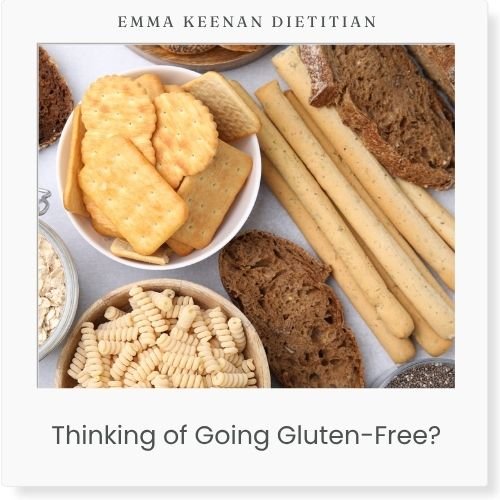
Gluten and lactose are the most common food components people cut out when experiencing gut issues. However, removing gluten before testing for coeliac disease is a common mistake that can make a future diagnosis much harder to obtain.
Whether you're struggling with bloating or just curious about gut health, here is everything you need to know about gluten, coeliac disease, and why those grains might actually be doing your gut a favour.

What is Gluten?
Gluten isn't just one thing; it’s an umbrella term for storage proteins—primarily prolamins and glutelins—found in wheat, barley, rye, and oats*.
These proteins are categorized by how they dissolve:
Albumins: Soluble in water.
Globulins: Soluble in salt water.
Prolamins: Soluble in ethanol (alcohol).
Glutelins: Soluble in acids.
Note on Oats: In Australia, if you have been diagnosed with coeliac disease, please consult a dietitian for the most up-to-date advice on whether oats are safe for your specific case.
Why We Love Gluten: Texture and Taste
Gluten is the "glue" of the baking world. It provides the structural integrity that makes bread chewy and pastries flaky.
Gliadin: Provides extensibility (stretchiness). It allows dough to rise with trapped gas and creates tender crumbs in cakes.
Glutenin: Provides strength and elasticity. It gives pizza dough its chew and helps croissants achieve those iconic crispy layers.

What is Coeliac Disease?
Coeliac disease is not a food allergy or an intolerance; it is a serious autoimmune condition.
When someone with coeliac disease eats gluten, their immune system overreacts and attacks the lining of the small intestine. This damages the villi—tiny, finger-like projections that absorb nutrients. When these villi are flattened, your body can't absorb water or nutrients effectively, leading to malnourishment and long-term health complications.
Coeliac Disease Statistics (Australia)
The stats are surprising:
1 in 70 Australians have coeliac disease.
80% remain undiagnosed.
As of 2024, approximately 309,714 Australians are living with the condition without even knowing it.
Why You Need To Keep Eating Gluten for Testing
If you suspect you have coeliac disease, do not stop eating gluten yet. The gold-standard blood test looks for antibodies your body produces in response to gluten. If you aren't eating gluten, your body won't produce the antibodies, and you may get a "false negative.
How To Get Diagnosed
| If You ARE Eating Gluten | If You ARE NOT Eating Gluten |
|---|---|
|
|
Reintroducing gluten after feeling better can be physically and emotionally taxing. It is much easier to get tested while gluten is still a part of your regular diet.
Common Symptoms of Coeliac Disease
Symptoms can be Classical (digestive) or Atypical (silent/outside digestive system).
Classical Symptoms
Bloating and abdominal pain
Diarrhoea or constipation
Iron deficiency (Anaemia)
Weight loss or fatty stools
Atypical Symptoms
Chronic fatigue and headaches
Early-onset osteoporosis or arthritis
Tooth enamel defects
Infertility or neurological issues
If Not Coeliac, Then What?
If your tests come back negative but you still feel unwell, you might be dealing with:
Wheat Allergy: An IgE-mediated allergic reaction (diagnosed by an allergist).
Irritable Bowel Syndrome (IBS): A functional gut disorder often managed by looking at FODMAPs rather than just gluten.
Non-Coeliac Gluten Sensitivity (NCGS): You react to grains, but don't have the autoimmune markers of coeliac disease. Research suggests you may actually be reacting to fructans (a carbohydrate) rather than the gluten protein itself.
Other Factors Affecting Your Gut
Gastrointestinal health is complex. Your symptoms could be triggered by:
Dietary Patterns: Fibre intake, food additives, or meal skipping.
Mental Health: The gut-brain axis means stress and anxiety directly impact digestion.
Lifestyle: Poor sleep hygiene and lack of rest.
Get Expert Support for Your Gut Health
Navigating gut issues alone is frustrating and often leads to unnecessary food restriction. If you’re ready to find the root cause of your symptoms and eat with confidence again, I’m here to help.
Discover Other Dietitian Articles
References
Biesiekierski, J. R. (2017). What is gluten? Journal of Gastroenterology and Hepatology, 32(S1), 78–81.
Cárdenas-Torres, F. I., Cabrera-Chávez, F., Figueroa-Salcido, O. G., & Ontiveros, N. (2021). Non-celiac gluten sensitivity: An update. Medicina, 57(6), 526.
Coeliac Australia (n.d). https://coeliac.org.au/learn/coeliac-disease/
Tuck, C. J., Biesiekierski, J. R., Schmid-Grendelmeier, P., & Pohl, D. (2019). Food intolerances.Nutrients, 11(7), 1684.
Mumolo, M. G., Rettura, F., Melissari, S., Costa, F., Ricchiuti, A., Ceccarelli, L., de Bortoli, N., Marchi, S., & Bellini, M. (2020). Is Gluten the Only Culprit for Non-Celiac Gluten/Wheat Sensitivity?Nutrients, 12(12), 3785.